 |
| Dog Violets (blue) and Greater Stitchwort (white) growing beside a lane near Dol y Moch This morning (24th April), I treated myself to a short walk along the lane in question where I took the above photo and saw the following wildflowers..........Lesser Celandine, Herb Robert, Bluebells, Dog Violet, Red Campion, Wood Anemones, Wood Sorrel, Wood Sage, Foxglove, Dog Rose,Wall Pennywort, Forget-me-not, Germander Speedwell..............and there will be many others that make their appearance later in the year.In addition there are countless species of non-flowering plants; mosses, liverworts, ferns and lichens.Our country lanes are indeed a work of art, hundreds of years in the making, a unique heritage.Go and enjoy them but remember they need protection; road widening or straightening or mowing verges at the wrong time of year can all damage or destroy this unique habitat. Migrant bird species have been arriving in an orderly sequence beginning with the Chiff Chaff on the 20th March and then in April, Blackcaps (2nd), Willow Warblers (13th), Pied Flycatchers(15th), Swallows (24th) and Wood Warblers on the 1st May. When the Pied Flycatchers (PFC) arrived the bird box they normally use was still plugged to prevent early use by BlueTits.We immediately unplugged the box and the next day (16th) the pair were staking their claim. On the 17th they were seen mating and two days later the female was carrying nest material into the box.A few days later they both disappeared leaving behind a well formed nest and that is the situation as I write (6th May). Not too far from the PFC nest box I came across the remains of a racing pigeon, mostly feathers strewn about a grassy bank, obviously used as a plucking ground. I suspect the culprit was a Peregrine Falcon that occasionally hunts above this spot.The photo below shows two of the feathers on which are stamped the bird's number (56), and the name and phone numbers of the bird's owner.  Still on the topic of birds,our resident Nuthatches have been using the same nest box shown below for the last three years. 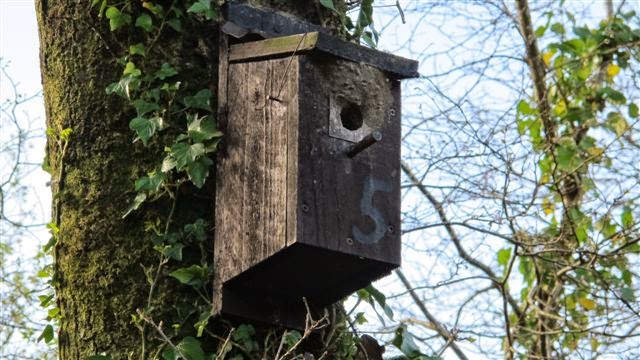 Below is a photo of Olwen, my farmer-neighbour, with one of her young lambs wearing a woolly black jumper. The jumper is not a fashion statement or a means to keep the lamb warm.It is the coat of a black lamb that was born dead.The white lamb is one of twins born to a ewe that was finding it difficult to feed both lambs.The obvious solution you may think, is to give one of the twins to the black ewe whose own lamb was born dead.  Not so easy..........because a ewe will recognise her lambs by their smell, rejecting those smelling of other ewes. So the farmer removes the skin and coat of the dead lamb and places it on the lamb to be fostered.The fostering ewe is tricked into thinking that the lamb belongs to her because it smells like her lamb. I'm happy to report that mum and baby are doing fine (see below)  Don't forget to check out my next blog as I have something horrendously smelly to tell you about! |
Tuesday, 6 May 2014
Life and death at Spring Time

Monday, 7 April 2014
Frogs and trees cross roads
At one stage road access to Dol y Moch was completely blocked by several fallen trees. (See below)
 |
| This is where the coach stops when dropping off or picking up school groups Sadly the lovely old cherry tree that once stood in front of the house and which produced spectacular displays of pink blossom each spring, is now no more, along with many oak trees in the Dol y Moch woodland. |
 |
| The end of the Cherry Tree |
But even in stormy February a few spring flowers were braving the weather, Lesser Celandine making an appearance on the 16th and Daffodils on the 20th.
In March the Jet Stream slipped northwards heralding a change to calmer conditions and a feeling that spring had finally arrived.(Well almost)
Wood Anemones in bloom were spotted on the 20th March, a single white Bluebell on the 30th, and on the 2nd April, Bluebells proper were beginning to flower.
A surge of unseasonal warm, dusty air coming up from Africa and the Mediterranean took my shade thermometer to just under 22 C on the 30th March; However, I understand that officially, Porthmadog was the warmest spot in Britain with 21C recorded!
Heavy rain on the evening of 31st coupled with the warm air brought masses of migrating frogs out onto the steamy roads......quite a wildlife spectacle but hellishly difficult for driving.That night I drove from Caernarfon to Porthmadog and had to dodge hundreds of frogs wandering across the road; fortunately their light coloured skin under their chins stood out in the car headlights so I was able to miss them by driving slowly and safely. However, noting the speed of other cars that evening it would appear that their drivers were either unaware of the frogs or unconcerned.............in both cases that was a pity.
Our migrant bird species began arriving on the 20th March but more about that in my next blog very soon.
Tuesday, 4 February 2014
Bluebells and Global Warming
This morning there were whining sounds of chainsaws from across the Glaslyn floodplain, the woodmen dealing with the trees that have succumbed to yet more gales.Ironically as I listened to the chainsaws I too was cutting and chopping wood from trees blown down in the storms of 2012!
The west coast of Wales has certainly taken a battering of late.Two days ago (1st Feb ) a Force 9 gale lashed the local coastline but today the wind had dropped to Force 5-6 . With the sun giving a rare appearance, I decided to venture down to the little seaside town of Criccieth to see how it had fared.
As expected the tide was very high, and huge waves were thumping against the seawall and esplanade,but no obvious damage was visible.However the cliffs on the west side of Criccieth had suffered severe erosion with large sections having collapsed into the sea.
Further along the coast where the land is lower the sea had surged over the top of the beach, scouring the land and dumping masses of sand, pebbles and sea borne plastic rubbish over a wide area.Most of the damage that I saw was actually caused by the severe storm on Boxing Day.
Although the weather so far this winter has been exceptionally wet and stormy, it has been mild and that has encouraged the spring flowers to start growing earlier. Our Snowdrops have been in flower since Jan 8th and the Daffodils are now 20 cm high.Bluebells have also made an appearance,their bright green shoots pushing up to 5 cm above ground as shown in the photo I took today (4th Feb )

There are also two other spring flowers in this photo; on the left with feathery leaves is Pignut and on the right,the heart shaped leaves of Lesser Celandine.
So the spring flowers are on the way but the Frog spawn is already here.............see below.

This small healthy clump I spotted today but I guess that it has been there for a couple of days..............so deposited probably at the beginning of Feb. Last year I noticed spawn in the same pond on 6th Feb.
It's lovely to hear the birds singing once again especially the Mistle Thrush calling from the tree tops.I even saw a pair of Robins mating which is very early indeed.There are plenty of ducks down on the marshes including Teal,Wigeon and Shovelers. Flocks of Canada Geese,Whooper and Mute Swans are busy grazing the farm fields.
On the 30th Jan I heard a Vixen barking at dusk from the woodland
near my house;checking my notebook I heard a vixen on the 20th January last year from exactly the same place.
If you are a regular follower of the Season Watch blog you will be aware that I record the occurrence of seasonal life cycle events of particular animals and plants as mentioned above.
Recording events like these and their relationship to seasonal climate and habitat influences is called Phenology and has proved useful in the study of Climate Change and Global Warming.
Using records compiled over many years has enabled scientists to monitor trends in animal and plant life cycles that can indicate changes in global temperatures.For example,the early growth of spring plants and arrival of migrating birds species indicate that Spring is beginning earlier as winters become milder.
The west coast of Wales has certainly taken a battering of late.Two days ago (1st Feb ) a Force 9 gale lashed the local coastline but today the wind had dropped to Force 5-6 . With the sun giving a rare appearance, I decided to venture down to the little seaside town of Criccieth to see how it had fared.
As expected the tide was very high, and huge waves were thumping against the seawall and esplanade,but no obvious damage was visible.However the cliffs on the west side of Criccieth had suffered severe erosion with large sections having collapsed into the sea.
Further along the coast where the land is lower the sea had surged over the top of the beach, scouring the land and dumping masses of sand, pebbles and sea borne plastic rubbish over a wide area.Most of the damage that I saw was actually caused by the severe storm on Boxing Day.
Although the weather so far this winter has been exceptionally wet and stormy, it has been mild and that has encouraged the spring flowers to start growing earlier. Our Snowdrops have been in flower since Jan 8th and the Daffodils are now 20 cm high.Bluebells have also made an appearance,their bright green shoots pushing up to 5 cm above ground as shown in the photo I took today (4th Feb )
There are also two other spring flowers in this photo; on the left with feathery leaves is Pignut and on the right,the heart shaped leaves of Lesser Celandine.
So the spring flowers are on the way but the Frog spawn is already here.............see below.
This small healthy clump I spotted today but I guess that it has been there for a couple of days..............so deposited probably at the beginning of Feb. Last year I noticed spawn in the same pond on 6th Feb.
It's lovely to hear the birds singing once again especially the Mistle Thrush calling from the tree tops.I even saw a pair of Robins mating which is very early indeed.There are plenty of ducks down on the marshes including Teal,Wigeon and Shovelers. Flocks of Canada Geese,Whooper and Mute Swans are busy grazing the farm fields.
On the 30th Jan I heard a Vixen barking at dusk from the woodland
near my house;checking my notebook I heard a vixen on the 20th January last year from exactly the same place.
If you are a regular follower of the Season Watch blog you will be aware that I record the occurrence of seasonal life cycle events of particular animals and plants as mentioned above.
Recording events like these and their relationship to seasonal climate and habitat influences is called Phenology and has proved useful in the study of Climate Change and Global Warming.
Using records compiled over many years has enabled scientists to monitor trends in animal and plant life cycles that can indicate changes in global temperatures.For example,the early growth of spring plants and arrival of migrating birds species indicate that Spring is beginning earlier as winters become milder.
Thursday, 26 December 2013
Seals, Snakes and Long-shore Drift

Back in November the children from Stoke Heath Primary school spotted this young Common Seal in the Dwyryd estuary near Borth y Gest. It would have been born during the summer, probably further along the coast of the Llyn Peninsula. Single pups are born on tidal rocks or sand banks and are able to swim and dive from birth.The other species of seal seen around our coast is the Grey Seal.The Common Seal can be distinguished from the Grey Seal by its smaller size and short muzzle with a concave profile between forehead and nose. Also the closely set nostrils form a V as clearly shown in the photo. Another unusual encounter occurred higher up the estuary when a canoeing group from Ernesford Grange school came across a huge wooden sphere, almost a metre in diameter, partially submerged in the river channel. Unbeknown to the students they had discovered a work of art on a journey through the landscape! The journey began in the 1970s when a local sculptor, David Nash, carved the giant ball from a huge fallen oak in woodland near Dol y Moch. When completed, the ball was rolled into the nearest stream with the idea of following its progress and interaction with the environment over time. I well remember watching its eventful journey down the stream over the years as I often visited that tributary stream with groups of students studying freshwater biology. People from all over the world would come to photograph the ball on it's journey as David Nash is a world renowned artist. Eventually the ball was washed into the River Dwyryd to begin its journey to the sea and beyond. Over the intervening years there have been many sightings as the ball was moved by the ebb and flood of the tide, but it would also disappear for years on end. So, by finding it, I think that the students from Ernesford Grange have made a significant contribution to the history of the Giant Ball!
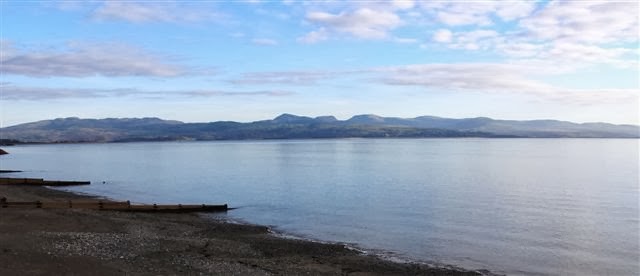 |
| Tremadog Bay from Criccieth with the Rhinog mountains in the background. November 2013 |
The groynes on Criccieth beach trap the eroding sand and pebbles and so maintain the beach. The beach in turn protects the Sea Wall, Guest houses and Hotels behind it. Next time you spot a groyne at the seaside, check the beach level on both sides: the highest side is the side collecting most transported material and therefore faces the direction of Long-shore Drift.
Moving inland now to my compost heap! I recently had a pleasant surprise when I discovered the remains of a snake skin (shown below) on the end of a bramble shoot that I pulled out of the heap. Snakes periodically moult their skin which can be used to identify the species to which it belonged.

The three native snakes in Britain are the; Grass Snake, Adder or Viper and the Smooth Snake. The latter species is very rare and confined to southern England. Therefore, the skin must have come from either a Grass Snake or Adder. Checking the shape of the preanal belly scale indicated that it came from an Adder, a very beautiful creature.
REMEMBER!
A bite from an Adder(Viper) is rarely fatal.
Keep calm.
Get help.
Avoid vigorous activity and never cut or suck a snake bite.
Wednesday, 27 November 2013
Plas Dol y Moch weather data for August, September and October.
|
Month
|
AUGUST
|
SEPTEMBER
|
OCTOBER
|
|
Days of precipitation
|
26
|
22
|
29
|
|
Total precipitation mm
|
171.3
|
136
|
207.2
|
|
Maximum precipitation mm
|
39.6 (5th)
|
21.79 (15th)
|
21.01 (20th)
|
|
Average temperature 0C
|
15.9
|
13.2
|
12.6
|
|
Maximum temperature 0C
|
26.3 (26th)
|
24.1 (4th)
|
19.9 (2nd)
|
|
Minimum temperature 0C
|
5.4 (25th)
|
4.4 (14th)
|
2.7(30th)
|
|
Average wind speed mph
|
0.6
|
0.4
|
1
|
|
Maximum wind speed mph
|
21 (17th)
|
17 (15th)
|
28 (26th)
|
|
Dominant wind direction
|
W
|
WSW
|
WSW
|
Date
shown in brackets
In general as
high summer merges into autumn the air temperature trends downward while
rainfall and windy conditions increase. The predominant wind direction was south of
west bringing warm, moist air from the Atlantic.However these data show that September was a quieter month weather wise.
Wednesday, 13 November 2013
Smells and Spores
During the first week of November Snowdon received it's first significant snowfall but since then it has been washed away by lashings of rain. Down at Dol y moch we experienced our first frost of the season when the temperature edged below zero to minus 0.2 C on the 9th of November.I live a few miles west of Dol y moch towards the sea and here the temperature only got down to plus 3 C thanks to the warming effects of the 'Gulf Stream'.Without the frosts the trees are still hanging on to their leaves.....the birches and Larch trees have turned a warm yellow and look striking against the dun hues of oaks.You might remember that I mentioned in my last blog the scents and smells of autumn.Since then I have taken the opportunity when out in the countryside to try and recognize individual scents and smells.For example,this morning I went for a bike ride to Aberglaslyn; my route took me across boggy flood plains, passed farms, through oak woodland dripping with dew, beneath tall beech trees standing in carpets of fallen leaves and finally into the gorge of the Afon (River) Glaslyn with its clear, cold water cascading over moss covered rocks.They all seemed to emanate their own distinct smell......it was fascinating.Next time you go for a walk, why not educate your nose!
Still on the topic of smell,over the last few weeks Ivy has been in flower producing a very distinctive musty ( not unpleasant ) scent.
Mushrooms and toadstools (fungi) are of course one of the star attractions of autumn and the damp, relatively warm weather has promoted the development of their above-ground spore producing structures (fruiting bodies).
There is a fantastic range of shapes, colours, textures and smells. Some fungi are edible but some are deadly poisonous. The Sulphur Tufts shown above are not edible and can be mistaken for the Honey Fungus, Armillaria mellea a deadly parasite of trees.Both species look very similar and both grow around the base of trees.
One way to tell the difference is to check the colour of their spores by making a spore print like the one shown below.
 To do this ,carefully remove the cap from the stalk of the mushroom and place it gills downwards on a piece of white paper and leave for a day.The spores will be released from the gills and deposited on the paper making a beautiful pattern identical to the gills.In this case the spore print colour is purple/brown which indicates that the mushroom is the Sulphur Tuft.In contrast,the Honey Fungus produces a pale cream spore print.
Down on the Glaslyn marshes I saw Greylag Geese, Goosanders, Little Grebe, Redshank, Heron, Wigeon and Turnstone. Lower down, at Borth y Gest, the children from All Saints and Earlsdon Primary Schools spotted a pair of Cattle Egret.
And finally there are still a few butterflies about like the Red Admiral in the picture below that was feeding on fermenting fallen apples in my garden between the 10th and12th of November.

Still on the topic of smell,over the last few weeks Ivy has been in flower producing a very distinctive musty ( not unpleasant ) scent.
 |
| Flowers of Ivy,Hedera helix showing stamen with pollen ( bottom right) |
 |
| Sulphur Tufts, Hypholoma fasciculare |
One way to tell the difference is to check the colour of their spores by making a spore print like the one shown below.

Down on the Glaslyn marshes I saw Greylag Geese, Goosanders, Little Grebe, Redshank, Heron, Wigeon and Turnstone. Lower down, at Borth y Gest, the children from All Saints and Earlsdon Primary Schools spotted a pair of Cattle Egret.
And finally there are still a few butterflies about like the Red Admiral in the picture below that was feeding on fermenting fallen apples in my garden between the 10th and12th of November.

Tuesday, 22 October 2013
Mists and Mellow Fruitfulness
I really look forward to the colours and smells of autumn and to those quiet days when the early morning mist hangs above the River Glaslyn.
 |
| The Afon Glaslyn looking north towards Moel Hebog
The mists had lifted when I took this photo but just out of view and to the right,Snowdon was still wearing it's cap of cloud.
On the left bank of the river, I could see patches of Michaelmas Daises mauve against the seasonal browns and ochre.
The flowers of Red Campion still linger along the roadsides at least until the first heavy frost. Red Admiral,Tortoiseshell and Comma butterflies are still on the wing and feeding on Sedum spectabile in my garden.
I mentioned in my last blog that 2013 has proved to be a 'Mast' year where bumper crops of fruit and nuts have been produced. Millions of acorns have been raining down from the oak trees bouncing off car windscreens and making walking and riding a bike a bit tricky as they act rather like marbles......and have you ever tried walking on marbles! At least there is plenty of food for the squirrels, mice, pigeons, jays, pigs and deer to name a few. Acorns do however contain toxins which can kill cattle if too many are eaten.
The species of oak tree that grow in Dol-y-Moch woodland, and in north and west Britain, is the Sessile Oak,(Quercus petraea).In Warwickshire and lowland Britain the dominant species is the English Oak (Quercus robur).How do you tell the difference?

Look at the photo above of Sessile Oak acorns and note that they are attached directly to the twig. Acorns of the English Oak have a little stalk 4-6 cm long.Go and check out the oaks in the Memorial Park!
Earlier this year while biking through deepest Shropshire I came across a most magnificent ancient English Oak shown below.
.JPG) |
I was keen to find out the age of this massive living thing.There is a method of estimating a tree's age by measuring the circumference of the trunk about one metre above the ground.By using a scale of 1 inch = 1 year an estimate of the tree's age can be derived.Unfortunately we did not have a measuring tape so we used our arms instead and arrived at a circumference of 240 inches which is equivalent to 240 years! So our oak tree was an acorn in the year 1775..........wow! What was happening in 1775? Magnificent trees like this one are part of our heritage and we must look after them.
I can't finish this autumnal blog without a few words about seasonal smells. Of late I have been enjoying kicking through piles of fallen leaves heaped about the woodland paths and tracks.I remember doing just this as a child and I still feel the same pleasure. Autumn scents are so evocative of childhood memories, especially the smell of a bonfire of dried leaves. Of course it is much more environmentally friendly to make a compost heap rather than a bonfire.
However, kicking through the autumn leaves releases lots of lovely scents into the air and this got me thinking about trying to describe the various smells that make up the scents of Autumn. If the fragrance could be bottled like wine, how would it be described on the label.............................'handcrafted by mother nature over millenia to create a mellow fruitfulness.........with hints of over-ripe apples and crisp dry leaves.........overtones of mushrooms and wood smoke with a long damp earthy finish. Best enjoyed in season and an excellent accompaniment to a brisk walk before breakfast'.
Carpe Diem
Wednesday, 25 September 2013
Berries,Butterflies and Badgers
 |
| Rowan Berries |
Back in August I was fortunate to observe the courtship behaviour of the Small White butterfly.After alighting on a leaf wings open, the female surprised me by suddenly extending her abdomen upwards so that the tip was elevated about ninety degrees above her body as shown in the photo that I managed to take.
 |
| Small White Butterflies (male left,female right) |
And lastly I discovered a hole in my lawn recently and initially suspected 'Peter Rabbit' was to blame.However, on closer inspection I noticed several dis orientated bumble bees crawling about in the hole whereupon my suspicions turned to another inhabitant of the Wild Wood. A large paw mark in the excavated soil confirmed my suspicions ........Mr Brock was the culprit! It is well known that badgers will raid bumble bee nests for their honey and wasp nests for the grubs.
Saturday, 17 August 2013
Butterflies,Birds, Burials, Bottles and Bye Bye!
It is now August 17th and the weather has turned a little unsettled, quite a contrast to the almost continuous hot and dry weather of June and July. Here in Wales we had very little rain during those months and on one day Porthmadog recorded the highest UK temperature......just over 34 degrees, as I remember! On the downside one our ponds dried up which was very sad as it contained hundreds of tadpoles. In contrast, the warmer dry conditions have given the butterfly population a boost. A poor summer last year had a severe impact on butterfly breeding success and survival rate. Consequently there were few butterflies to be seen on the wing in spring and early summer and these were mainly white species. Of late, though, I have seen more coloured species such as Red Admiral, Ringlet, Small Tortoiseshell, Peacock and Meadow Brown but in reduced numbers. During July we did look out for Glow worms but like last year we were unsuccessful........perhaps the cold and wet of last year took its toll of this species too. However, I did come across a colourful Sexton Beetle also known as a Burying Beetle.
As both names imply, this beetle is involved in burying things such as small dead birds and mice on which it lays it's eggs. On hatching from the eggs, the larvae feed on the rotting corpse.The picture above is not of the beetle I found as that one flew off before I could photograph it!
The image above was taken in June and at this time some of the steep sea cliffs were crowded with breeding seabirds........Guillemots, Razor-bills and Kittiwakes. In a kayak you can get close to the colonies without disturbing the birds. It was quite a spectacle with hundreds of birds on narrow ledges high above us, screeching away and sometimes poohing on unsuspecting kayakers.
 |
| Sexton Beetle a.k.a. Burying Beetle |
In June and July I took my kayak to the north and south coasts of the Llyn Peninsula and in contrast to the normal temperature, the sea water felt like hot bath water.In June there were very few people about but in July it was a different matter with speed boats and jet skis whizzing about all over the place.However, in amongst all this action a pod of 6 Bottle-Nosed Dolphins came cruising by unseen except by us and one other boat .
 |
| Peaceful paddling on the Llyn Peninsula |
On a beautiful July morning we paddled out to an isolated sea stack and quietly observed a group of Common Seals with their pups lulling on the rocks. Some of the pups were wailing and I could imagine how eerie this sound would have been if instead of blue sky and sunshine we had been enveloped in a grey cold sea-mist!
Dare I mention it but the end of the summer holidays looms ever closer and so does autumn. Not that I'm wishing summer away but subtle changes are taking place in the countryside which herald the 'season of mellow fruitfulness'. The birches are showing a hint of autumn colour and some bracken fronds have turned yellow. Birds are returning to the feeders as the glut of caterpillars subsides and woodlands are now quieter places with fewer birds singing.Out and about the toadstools are appearing with the damper weather so it is time to get my Guide to Mushrooms and Toadstools off the shelf............there is always so much to see. And before I forget.....if you have been following our Pied Flycatcher story........it all ended happily.The eight eggs that hatched produced eight chicks that flew from the nest on the 14th June.My wife tells a nice and true story about their departure.On the very day they left, the male bird flew across to the vegetable garden where my wife was working. He perched on a post right next to her (never having ventured that close before) and looking at her burst into a little song and then was gone...........was he saying good-bye?
And finally, I heard from Faf that otters were seen by Dol y moch canoe groups at the end of last term.So if you are due to visit us this coming term keep a lookout for otters!
Weather Data for June 2013
Plas Dol y Moch Weather Data for June 2013
|
Month / Year
|
June 2013
|
|
Days of precipitation
|
13
|
|
Total precipitation mm.
|
86.2
|
|
Maximum precipitation mm.
|
15.2 (22nd)
|
|
Average temperature 0C
|
14.2
|
|
Maximum temperature 0C
|
24.3 (18th)
|
|
Minimum temperature 0C
|
5 (3rd)
|
|
Average wind speed mph.
|
1
|
|
Maximum wind speed mph.
|
19 (23rd)
|
|
Dominant wind direction
|
WSW
|
Wednesday, 10 July 2013
Meadows, Bee Orchids and Pot-Pourri!
With temperatures hovering around 30C for the past few days I think high summer has arrived and definitely time 'to make hay while the sun shines'. Our wildflower meadow mentioned in my earlier blog was a riot of colour and insects back in June,but on the 5th of July it was cut to make hay.Five days later under a baking sun the hay was baled after being repeatedly turned and dried in the sun during the intervening days.In a damp corner of the meadow is a colony of Heath Spotted Orchids ( I counted 132 plants) many of which had not set seed.These plants were cordoned off and not mown to allow them to finish flowering.This year has been a good one for orchids.I saw huge numbers of Heath Spotted Orchids on a recent trip to the Outer Hebrides.Further south in the Cotswold while walking in the valley of the Windrush I came across three spectacular Bee Orchids right next to the footpath ..........wow!But the best was still to come; last week I took a walk in the sanddunes at Morfa Harlech and found another five Bee Orchids and hundreds of Pyramidal Orchids,Northern Marsh Orchids and Marsh Helleborines.
In addition to the orchids there were lots of colourful plants including Evening Primrose, Ladies Bedstraw, Carline Thistle, Rest Harrow,Portland Spurge, Birds-Foot Trefoil and Yellow Rattle.
I wonder whether any former A-level Geography and Biology students will read this and remember their field work in Harlech dunes? The one thing I remember is always smelling like 'pot-pourri' after spending a day in the dunes with all those lovely scented flowers!
 |
| Bee Orchid |
I wonder whether any former A-level Geography and Biology students will read this and remember their field work in Harlech dunes? The one thing I remember is always smelling like 'pot-pourri' after spending a day in the dunes with all those lovely scented flowers!
Monday, 10 June 2013
Plas Dol y Moch Weather Data
Month / Year
|
May 2013
|
Days of precipitation
|
18
|
Total precipitation mm.
|
93.8
|
Maximum precipitation mm.
|
18.01 (9th)
|
Average temperature 0C
|
10.7
|
Maximum temperature 0C
|
23.9 (7th)
|
Minimum temperature 0C
|
0.3 (1st)
|
Average wind speed mph.
|
1.4
|
Maximum wind speed mph.
|
26 (24th)
|
Dominant wind direction
|
WSW
|
May was a very quiet month weather wise with low rainfall and no frosts. As I write (10th June) there has been no rain for two weeks and the water levels in local streams and rivers are very low. A kayak trip along the north and south coasts of the Lleyn Peninsula was rewarded with sightings of Bottle-Nosed Dolphins and large numbers of Razorbills,Guillemots and Kittiwakes nesting on the steep cliffs. Swarms of Garden Chafers can be seen flying over the grassy fields and lawns providing a tasty feast for the nesting birds feeding hungry chicks. Our Pied Flycatchers are doing well; all eight eggs hatched and the chicks look fine.Lots of newts have been found in the Dol y Moch slimy pond!
Subscribe to:
Posts (Atom)